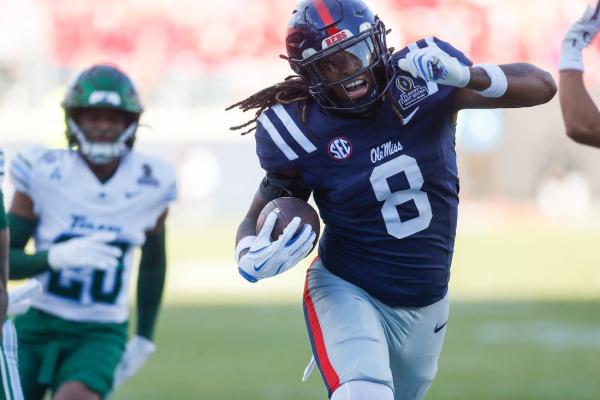
Louisiana district court judge William Jorden approved a preliminary injunction on Thursday that would allow LSU to add tight end Dae’Quan Wright and defensive lineman Zxavian Harris to its roster after their brief stints in the NFL.
After a lengthy court hearing in Baton Rouge, Wright and Harris were among 42 athletes across multiple sports who were granted an additional year of eligibility in the wake of the NCAA’s pivot to a new 5-for-5 eligibility system.
Both Wright and Harris, who previously played for new LSU coach Lane Kiffin at Ole Miss, said they intend to join the 11th-ranked Tigers before the team’s roster is finalized on Friday ahead of the home season opener against Clemson on Saturday.
Wright signed with the Philadelphia Eagles as an undrafted free agent in the offseason, then was claimed off waivers by the Cleveland Browns, who subsequently waived him last week. Harris signed an undrafted free agent contract with the New Orleans Saints before they waived him in early August.
While the Southeastern Conference and NCAA have spoken out against players who signed NFL contracts returning to college — the SEC filed a federal lawsuit against Kiffin and a host of LSU administrators earlier Thursday in Alabama in an attempt to prevent the players from returning — the injunction, as it currently stands, prevents the SEC or NCAA from penalizing LSU or any other school for adding the players included in this case to its roster.
The SEC passed a rule last week that permitted commissioner Greg Sankey to punish any school that added players who signed NFL contracts to its roster. A half-season suspension of the head coach and a fine of half of the school’s athletic budget for that sport were the prescribed penalties.
The SEC passed the measure regarding the penalties by a 15-0 count, with LSU abstaining.
The SEC released a statement after the judge’s Thursday ruling: “We disagree with the court’s decision. The SEC’s presidents and chancellors unanimously adopted a clear and reasonable standard: member universities should not place former professional athletes on their rosters. The conference and its member universities have the right to establish, through agreed-upon governance procedures, the rules under which they voluntarily compete and to expect those rules to be followed.
“The SEC will continue to defend this standard, the principle of fair competition, and the conference’s authority to govern competition among its member universities.”
The attorney representing Wright and Harris said in court Thursday that the conference added more specific rules to its ruling last week to work around a judge’s orders.
“That sounds an awful lot like wide-open collusion,” Jorden said while presiding over closing arguments, per ESPN.
The SEC’s federal suit alleges that LSU is violating the conference’s First Amendment right of expressive association by ignoring longstanding rules against rostering professional athletes.
The SEC is seeking a preliminary and permanent injunction “prohibiting the defendants from violating the conference’s First Amendment rights by compelling the conference to associate with conduct that is contrary to the Conference’s purpose and mission.”
The suit maintains that LSU “waged a deliberate and coordinated campaign to recruit professional athletes to play football for LSU during the 2026-27 season.”